


The dog you’re treating for pancreatitis isn’t responding as expected, and it’s time to think about adjusting your plan. But your next appointment is already waiting, and there’s a drop-off patient you haven’t had a chance to look at yet. You don’t have time to work through every possibility, but you still need to know what to do next.
So where do you turn?
Where VIN Fits in Veterinary Practice
The Veterinary Information Network (VIN) has been a staple for veterinarians for decades, and for good reason. Specialist perspectives, peer discussion, and a CE library give you insight into how colleagues think through cases. That kind of depth is very valuable.
However, VIN is centered around discussion, and that’s not always what the moment calls for. When you’re mid-shift, opening multiple threads leaves you sorting through different perspectives and approaches. You’re more informed, but you still have to figure out where the information is coming from, how much you can rely on it, and how to apply it to the patient in front of you. And you’re doing all that against the clock.
That’s not a flaw in VIN. It’s just the nature of community knowledge. It’s valuable for learning, but harder to act on in the moment when you have a patient waiting on the treatment table.
VIN gives you discussion. In that moment, what you need is direction.
Where Standards of Care Makes the Difference
When you need to know what to do next, Standards of Care puts everything you need to manage a case in one place.
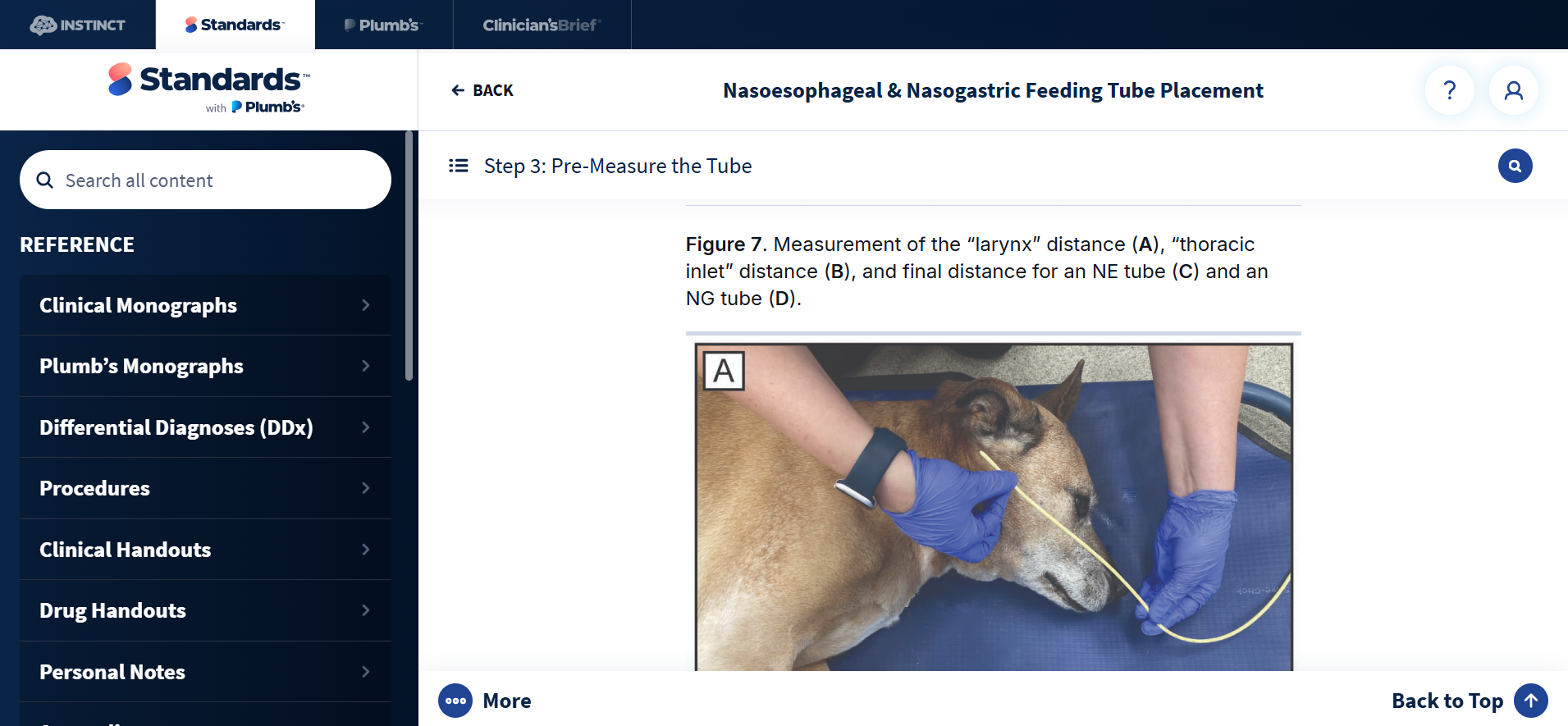
When that dog with pancreatitis is still anorexic, you’ve got 225+ peer-reviewed differential diagnosis lists and step-by-step algorithms to help you work through the possibilities. A library of more than 720 clinical monographs brings together real-world diagnostic and treatment guidance from presentation through follow-up. And when you decide to place a feeding tube, there’s a procedure guide with visual, step-by-step support.
When it’s time to prescribe, your veterinary drug reference is right there. Plumb’s is built-in with drug dosing guidance and the industry’s only veterinary-specific drug interaction checker, so you can make safe, confident prescribing decisions.
Once you’ve got your plan, you can share veterinary medication guides and condition handouts with clients so they know exactly how to manage care at home. More than 550 drug handouts and 400 clinical handouts are available, all reviewed by pet owners so they’re easy to understand. Many of the most commonly used handouts are also available in Spanish, helping you communicate clearly with clients across language barriers.
And Standards isn’t just for veterinarians. Your entire team can access the same guidance, use the same handouts, and stay on the same page with patient care.
Ready for clinical support from diagnosis to discharge? Subscribe to Standards today.
What Changes When You Have a Clear Answer
That means less time searching and second-guessing, and no more wondering whether the information is trustworthy or up to date. Everything is written and continuously reviewed by veterinary experts, and you can see who wrote it and when it was last updated.
For experienced veterinarians, it’s a quick way to confirm your treatment plan and make sure you’re not missing anything. If you’re early in your career, it gives you a framework to lean on so you can decide what to do without falling behind or relying on a busy senior colleague.
Knowing What to Reach For
VIN is a community and a career companion. It’s where you learn from colleagues, explore different approaches, and stay connected to the profession. Standards is built for those moments when you have a patient in front of you who needs a decision, and you don’t have time to second-guess. They each have a place in practice, and many veterinary teams rely on both. What you reach for comes down to whether the situation calls for a conversation or a clear answer.
The best way to understand the difference is to see Standards in action. Watch a free demo to see how it can support you and your team.
Julissa Treviño, Product Marketing at Instinct, contributed to this article